- Tíðindi, mentan og ítróttur
The true meaning of home

In last year’s Flag Day speech in Tórshavn, Indian-born Kalpana Vijayavarathan spoke about inclusion seen from an immigrant’s perspective.
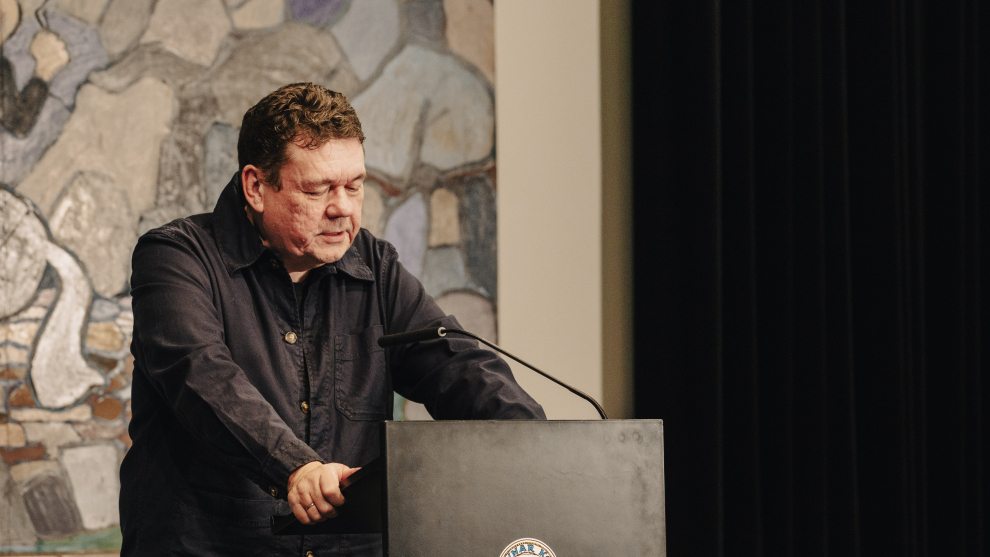
Immigration and integration were also the subject of this year’s Flag Day speech in Klaksvík, where David Im spoke about how his definition of ‘home’ has changed over many years of living in several countries.
Born in South Korea, David has lived in four other countries and spent the past ten years in Klaksvík. He works as the integration coordinator at the Immigration Office in Tórshavn.
Here is his English version of the speech, which he delivered in Faroese on Flag Day 25 April.
Home is where the anchor drops
"Have you ever experienced that feeling when you are on holiday and you are ready to go home? And as you land, you hear “vælkomin heim,” or when you drive out of Norðoyatunnilin and see the fishhook and the Kunoy mountain, you feel a sense of relief, happiness, and a burden unloading as you enter your home? Many of you know this feeling.
In fact, if I asked you where is your home, you wouldn’t hesitate to answer me right away. But for me, the word “home” has an even deeper meaning, one that is life-changing. When I was six years old, my parents told me that we were moving to England. I remembered the anticipation of meeting new people who have blonde hair and blue eyes like I saw on TV. I was excited to live in a “house” instead of an apartment in a tall apartment complex among millions of people in Seoul. I couldn’t wait to fly in an airplane and land in a foreign country and try all the new things I had never seen before.
However, the excitement faded quickly. I couldn’t speak English back then, so I couldn’t communicate. It rained almost every day (I know some of you guys are thinking it’s the same here). You couldn’t play with friends without making arrangements. And there was poop everywhere! Nobody picked up their pets’ poop! I felt disgusted, defeated, and down. I wanted to go home!
But what I called home back in Korea was not my home anymore. Life moved on. People moved. New buildings were built. Now I felt like an outsider, a stranger, and this feeling followed me throughout my journey. When I lived in Yemen and Germany, I was part of a small international community. We were on the outside of society. I even chased after the American Dream when I lived in America for over nine years, thinking one day I would hold an American flag in my hand and call it home. But no, I didn’t feel like I belonged anywhere. I was a traveler passing by.
Until now.
Today, I hold the Merkið flag in my hand and call it home. The flag brings a sense of pride, a national identity, and recognition. But for me, it also symbolizes home, my anchor, my place of belonging.
So what changed? How did I go from calling myself “homeless” after living in five countries to calling the Faroes my home?
If we start by looking at the technical definition of home, it means a place you live permanently. We also use location, geography, and even the amount of time you have lived there. But home can also be defined outside of these measurements.
Home can also mean a sense of belonging: a belonging to your family, a belonging to your friends, a belonging to your community. Klaksvík is full of these examples: in the 90s financial crisis, people came together to help each other, creative people came together to realize exciting ideas such as Íverksetarahúsið and Summarfestival, and yes, people coming together when KÍ plays a football match. We create that sense of belonging when families and friends come together to create shared experiences or communities come together to help each other.
I can’t tell you when, in the exact moment or how, you can tell yourself, “Now, I belong here.” For example, during my early years in the Faroes, people asked me where I was from. I replied “Korea,” which immediately prompted the response, “Oh, that’s good! We need new blood in the Faroes!” or someone called me a true local for being extremely nosy when I drove by slowly to see what was happening at a house full of people. I think I can safely say that these were compliments, but they didn’t make me feel like I belonged there.
For me, a sense of belonging came from moments of acceptance and understanding from my family and community. I can’t imagine what my parents-in-law were thinking when I arrived at their doorstep for the first time, a stranger from thousands of kilometers away coming to get married to their daughter, or when I popped into a local fitness center to ask if I can train people or proposing to the Kommuna to do an integration project. A stranger coming from the Far East living in the far North was accepted into the community.
Through my work with integration, I've also seen how people can learn, understand, and accept others despite cultural differences and communication barriers. What I have experienced over and over is that people are willing to learn and understand. Last year, when the Faroe Islands received Ukrainian refugees, the community took them in and supported them, creating a sense of home and refuge for them. Not too long ago, I asked a group of Ukrainians to share a funny experience they had in the Faroes. There were one or two stories, but most shared their gratitude for how the Faroese community took them in and supported them. They were thankful that we accepted them despite them being strangers. For them, Merkið means a place of home, refuge away from war and conflict.
I wonder if Emil Joensen, Janus Øssurson, Pauli Dahl, and Jens Olivur Lisberg would have ever dreamt that this flag, Merkið, would not only become a symbol of independence but a symbol of refuge and hope. A symbol not only for the Faroese people but for people around the world. Who would have imagined over 100 years ago when Merkið was presented to put the Faroe Islands on the world map to be recognized, that today, the world has come to recognize the Faroes right here in Klaksvík?
And the Faroese history shows that the islands have always been a destination. Monks and Vikings have come to the Faroes. Young Faroese people and families are moving back home. And now, on these 18 islands of over 54,000 people, we have people from 110 countries living among us. The world is here, and people look at the flag, Merkið, and call it home. This did not come with great achievements or international relations, but it came with acceptance and belonging, right here among us.
Today, we celebrate Merkið together from around the world. We can find pride that people from Korea, Philippines, Indonesia, America, and many other countries around the world are gathered here in the Faroes celebrating together, holding Merkið in their hands, calling it our home, our Faroe Islands.
Thank you."
More Faroese News in English.