- Tíðindi, mentan og ítróttur
The Prime Minister’s New Year’s speech
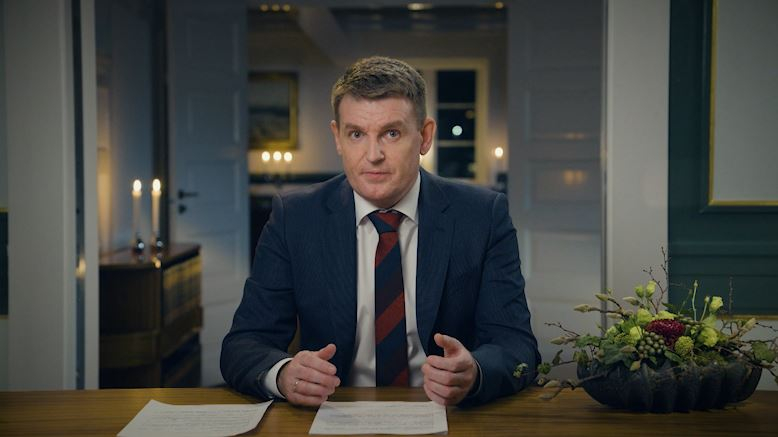
Dear people of the Faroe Islands.
Thick snowflakes fell silently on this cold and quiet Christmas evening in 1914.
The snow drifted down on the many soldiers sitting in the trenches of the Western Front in France.
World War 1 was raging, as British and French forces fought to keep the Germans out of France.
The fighting was brutal. But silence reigned on this Christmas evening as soldiers on both sides sat waiting in the cold trenches.
Suddenly, from the German trenches a clear voice cut through the cold air. A singing voice with increasing intensity.
Other voices hesitantly joined in the singing. Before long, German, English and French versions of ‘Silent Night’ were heard across the scarred battlefield.
A German soldier rose from his trench in clear view of his enemies. Standing tall, he gambled his life on a fragile hope of Christmas peace and shared humanity.
No shots were fired. Instead, soldiers on both sides rose from their trenches.
The two sides approached each other and exchanged greetings.
The soldiers shared what they had of food, cigarettes and other supplies. They played football on the snowy ground. They realised that the enemies they were trying to kill were not much different from themselves after all.
Despite representing opposing political ideologies, the soldiers embraced a special moment in which they looked beyond what divided them and celebrated what they had in common.
***
Dear people of the Faroe Islands
War is about frontiers. About boundaries between states and their citizens.
This event from 1914 teaches us that despite our disagreements on these boundaries, our shared humanity can transcend physical borders and unite us. There is now an increasing need for such unity.
Because, dear people of the Faroe Islands.
There is no doubt that the world is changing.
Our part of the world has enjoyed peace for decades, and the boundaries – between nations and their people – have been blurred.
We are currently witnessing two seemingly endless wars. We are witnessing atrocities we could never have imagined.
On 7 October, Israel suffered a devastating terror attack. What is happening in Gaza today is equally devastating. Thousands of civilians from both sides of the conflict have been killed. I have no words to describe these atrocities. And the war in Ukraine has been raging now for almost two years.
In a recent TV documentary, 25-year-old Ukrainian refugee Alyona Fedotova said:
”I am homeless. I have no job. I am all alone. I have lost my family, my country and people I love. I have lost my home.”
Here in our peaceful Faroe Islands, we struggle to understand this heartbreaking situation.
Countless tragic tales also emerge from Russia, where men across generations are being forced to go to war. Just like the soldiers in 1914, these men know that the enemies they are trying to kill are not much different from themselves.
It is hard to believe that despite all we have learned from history, we are still plagued by war and bloodshed.
Some boundaries, however, demand our unwavering defence, even if our lives are at stake. Boundaries so vital that we are willing to do everything to prevent them from being broken. These are the boundaries between freedom and oppression. Between fear and safety. Between suffering and joy.
It is my sincerest hope that peace will prevail soon. That the border between Russia and Ukraine is respected. And that borders are established between Israel and Palestine that both sides can accept, thus ending the suffering on both sides.
But the ripple effect from these wars is spreading. Walls of distrust are yet again being built between nations. The struggle for the truth is hard, something which is also evident here in the Faroe Islands.
***
Because as real-world walls solidify, the internet dissolves all boundaries. Technology has no limits. ‘Vitlíki’ (artificial intelligence), recently voted word of the year, has already surpassed human intelligence, long before we have grasped its full potential and perils.
My sons often tell me that I know nothing about technology. And they are right. Our minds struggle to understand the complexities of the online universe. Artificial intelligence offers us limitless possibilities for positive change.
It can help people who have disabilities. It provides valuable assistance in healthcare. And it can perform tasks in seconds that human experts would spend hours and days to complete.
We must learn to harness this technology. To integrate it wisely. And we need to safeguard ourselves and our children.
Because anything that is limitless poses risks. If there are no boundaries, we risk losing ourselves.
We need to determine boundaries between truth and falsity, between right and wrong. Boundaries between what we are willing to accept – of ourselves and of others.
But AI has no boundaries, neither human nor moral. This makes it difficult to navigate because how can we tell whether what we read or see is really true?
Photos. Letters. News. Media interviews. Video clips. What is true? In relation to the ongoing wars, but also in any other context.
This trend is already apparent. We are exposed to this information war every day. And the algorithms make sure that every single click on the mouse represents one dig further into the trenches. The algorithms do not expand our horizons – they shrink them.
The algorithms make us believe the world is black and white. They reduce complex issues to simple binaries: yes or no, for or against. They leave us blind us to all the nuances of life.
This affects the world. It affects our debates, and it can also affect democracy. Not only abroad, but here in the Faroes, too.
***
Dear people of the Faroe Islands We have recently seen people rally together on polarising issues such as the conflict in Ukraine, our fisheries deal with Russia, Israel and Gaza, abortion, LGBTQ+ rights and religious influence.
I have recently seen more such demonstrations than ever before. The boundaries are being drawn up.
It is good that we can all express our views. Free debate is the cornerstone of society. Of democracy.
But politics and legislation are also about boundaries. When the current government took office, we set out to adjust some boundaries – like all governments do. And when boundaries are adjusted, some rejoice. Others are disappointed, and some respond with anger. It all depends on which side of the boundary they stand.
Today, as in 1914, we are all better off if we dare to step out of our trenches and allow for an open dialogue despite our differences about the boundaries. There will always be arguments for and against.
Open dialogue, not digital trenches, is our only escape from the suffocating echo chambers that the internet leads us into.
We must set boundaries. But we must also build bridges.
This applies across the board – in fisheries, in trade and in the longstanding debate on roaming the countryside. And also with regards to moral, ethical and political boundaries.
This is not an easy task. Because we are highly divided on where the boundaries should be set.
However, despite our different views, we are all humans, first and foremost.
Here, I would like to highlight a role model. In October, when Bernhard Petersen, of the Salvation Army, received the annual Mental Health Award for his work with homeless people, he said:
”These are human beings. Our fellow humans (…) We should love them and take care of them. We must be able to look ourselves in the eye and know that we do the right thing for all human beings.”
This is the very core of humanity: our ability and willingness to take care of others. All types of people. Even those with widely different opinions to our own. Just like the soldiers on that Christmas evening in 1914.
We have many great role models in the Faroe Islands. Many good people who make a difference and spend their time and energy on doing what is right. Randi Waag Jacobsen recently explained how she helps Faroese households who struggle financially. She quoted a child as saying: “Look Mummy, here comes that woman who gives us food.”
All of you who do good deeds for others, you are the beating heart of our society. You act swiftly and compassionately – and you work much more smoothly than the political system ever will. You inspire us as a government. Although the government does its very best, it is difficult when circumstances change from one day to the next. From my heart, I wish to thank all of you who touch the lives of your fellow humans. Together, we can create a safety net for every person in our country.
***
Dear people of the Faroe Islands. On this final evening of the year, we look back on an eventful 2023 – and gaze into the year ahead.
A breakthrough – a key milestone for our society – is that Sandoy is now connected by road to Streymoy. This pushes our society forwards, uniting us and opening up a world of possibilities – in trade and industry, in sports and in family life – especially for young families living in Sandoy.
Although the cost of living has risen – and I am fully aware of this problem, not least for young families – there are jobs for everyone and plenty of activity. There are signs that inflation is easing, and we hope that interest rates will come down next year.
Despite challenges, we have a lot to be grateful for. We live in one of the best countries in the world. A country with great prosperity. With great freedom. With great safety.
We still have a strong sense of cohesion. We still find ways to bridge the trenches with open dialogue.
This remains one of the best countries in the world for children to grow up in. If not the very best.
Nevertheless, our greatest challenge today is that despite a growing population, our birth rates are falling.
This is a serious issue which we must work together to overcome. Some steps have already been taken. For the first time ever, we now have a Ministry of Children. We have provided tax breaks that will benefit young families. And we are building upon the previous government’s efforts to improve our schools.
But we must make it a key objective to adjust even more boundaries so that we can reverse this trend. We must do everything we can to make this an attractive place for children, young people and families to live and flourish.
***
The coming year starts with breaking a major boundary. For the first time, the Faroe Islands will be competing in a European championship for teams. The whole of the Faroe Islands will cheer on when the men’s national handball team steps onto the pitch in Berlin. No-one other than the young players themselves believed this would be possible. Competing in this event is a sporting sensation in itself, and I am excited to see how this huge feat will impact our country, our people and our sporting community.
The coming year will also see preparations for the Island Games, which the Faroe Islands will be hosting in 2027. This event will also serve to unite and benefit our society. In our everyday lives, where we often find ourselves divided, sport has a special way of uniting us all.
***
Dear people of the Faroe Islands.
With only a few hours remaining of this year, let us look back on 2023. Let us remember our hopes, our dreams and our resolutions from New Year’s Eve in 2022. But also our concerns, fears and anxieties.
Did your wishes come true? Or did your worries take hold? Was the year a great success – or did life throw you off the rails?
When, on New Year’s Eve, we take the time to reflect, we discover the depths of our own potential. But we also realise the limited control we have over what really matters.
It is at the intersection of these realisations that we humans function and live. Between our potential and what fate offers us.
Those of you who feel anxious about the year ahead are familiar with this dilemma. It is my wish that the coming year will fill you with comfort and hope. I wish you courage to seek help. And may the new year reveal to us all the true value of a helping hand in times of need.
For 2024, I wish that we all cherish and protect certain boundaries, while we adjust others to make way for progress. And, even when opinions clash, may we never lose sight of our shared humanity. Let us rise from our trenches, extend hands across the political and personal divides and embrace our fellow humans with compassion and understanding.
Happy New Year, dear people of the Faroe Islands. May God bless this coming year.
Hear the Faroese version of the speech here.
English version by prosa.fo.
More Faroese News in English.