- Tíðindi, mentan og ítróttur
Covid made us reflect on life

Two days after the Faroes went into partial lockdown in March 2020, researcher Erika Anne Hayfield asked Faroese people to report on their experiences in their diaries.
Participants were asked to describe their observations, feelings and experiences of being in lockdown.
In total, 51 diaries and follow-up interviews with one-third of participants formed the basis of Hayfield’s study, titled “Resilience processes during lockdown: a diary study from the Faroe Islands” and published in the Scottish Geographical Journal.
Making sense of it all
The study set out to explore resilience processes in the Faroes during the pandemic, asking how smallness and place shape resilience.
As a crisis is often understood in retrospect, the use of the diary method enabled an ongoing documentation of what people were going through as the situation unfolded.
The researcher used the concept of the cosmology episode to analyse resilience processes as sensemaking during lockdown, ranging from sense-losing (meaninglessness) to sense-remaking (trying to make sense of the new reality) and renewal (embracing the new reality).
The new normal
A common thread in the diaries is that the sudden change brought about by the pandemic made people reflect more deeply on their lives.
During the sense-losing stage, many diarists wrote about the past, including reflections on how their personal stories relate to those of their ancestors.
However, writing history backwards to establish and restore our identities also involves thoughts about the future.
Many diarists reflected on where they, their loved ones and the world as a whole were heading. A common theme here was how we humans can adapt to this new reality, with frequent suggestions that we should live more ethically in our relationships with other humans and with nature.
Island cohesion helps shape resilience
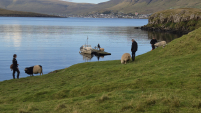
The feeling of being isolated in the North Atlantic – conceptually known as ‘islandness’ – contributed to a renewed assessment of the Faroese national identity in many diaries.
A key conclusion of the study is that the Faroese cultural cohesion played a crucial role in shaping the resilience processes during the pandemic.
This became particularly clear in relation to location (geographical isolation), spatiality (as opposed to density), politics (including autonomy), island culture, smallness and close relations.
In general, the diaries suggested that the early days of the pandemic gave rise to new perspectives, new emotions and changing relationships between people, places and the outside world.
Read more about the study (in Faroese) here.
The full article can be accessed here from the University of the Faroe Islands or the National Library.
Read the Faroese version of this article here.
More Faroese News in English.